
A Response to the New York Times Article:
“A Trump Order Protected a Weedkiller. And Also a Weapon of War.”
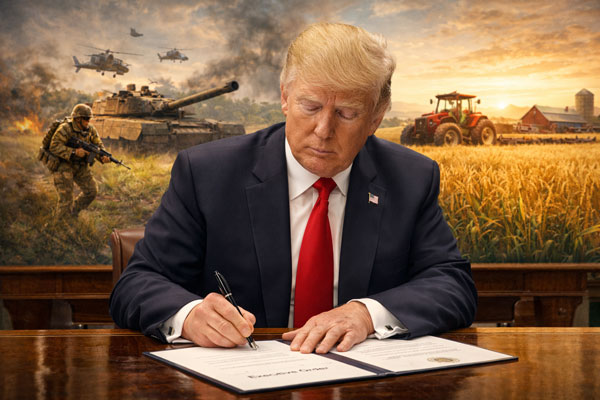
The same industrial facility producing the herbicide Glifosato is also the only domestic source of White Phosphorus in the United States.
That fact alone should cause every American to pause.
Because it forces us to confront a disturbing truth:
Modern industrial agriculture and modern warfare share the same chemical roots.
Most Americans believe war and farming have nothing in common.
War destroys life.
Farming feeds it.
But the disturbing fact is the same industrial system producing the herbicide sprayed on millions of acres of farmland is also tied to the production of materials used in military munitions.
At the center of the story is Glifosato, the active ingredient in Roundup, the most widely used herbicide in the world.
According to a recent New York Times report, the facility that produces key materials used to manufacture glyphosate is also the only domestic source of elemental phosphorus used to make white phosphorus, a chemical used in incendiary weapons.
White phosphorus burns intensely when exposed to oxygen and can cause devastating injuries.
“It has horrible humanitarian consequences,” said Bonnie Docherty, a senior adviser at Human Rights Watch and director of the Armed Conflict and Civilian Protection Initiative at Harvard Law School. “It causes really deep burns,” she said. “It’s notorious because it burns when exposed to oxygen, and wounds often reignite when bandages are removed.”
Yet the same industrial supply chain supports the herbicide sprayed on crops that end up on dinner plates across America.
That overlap is not an accident.
It is the legacy of a chemical industry built during wartime and later redirected into agriculture.

From Battlefields to Farm Fields to Military Food
After World War II, chemical manufacturers such as Monsanto Bayer (Part of IG Farben), Dow, Dupont and BASF that had expanded rapidly through military contracts began searching for new markets.
Agriculture became the perfect outlet for war chemicals.
Will Allen wrote a book about it called The War on Bugs.
Technologies originally developed to destroy vegetation or incapacitate enemies were repackaged as pesticides and herbicides.
One infamous example was Agent Orange, produced by Monsanto (acquired by Bayer in 2018) sprayed across millions of acres during the Vietnam War.
The chemical caused catastrophic environmental damage and continues to cause birth defects and disease generations later.
The same philosophy of chemical control later became the foundation of industrial agriculture.
The battlefield chemicals used in warfare have transitioned into the food supply and have recently been shown to be present in 100% of military food.
100% of 62 pesticides found in military food are produced in China, a historically enemy country. The majority of the 15,254 shipments of glyphosate to the USA in 2023 were from China. In fact, one report states that 99% of the glyphosate used by American farmers comes from China. Chemicals that kill are sold to our farmers with false claims of safety, and we are willingly poisoning our citizens, farmlands, waterways, wildlife, soldiers, and students.
The fact is that our military is being compromised by Chinese chemicals. It is silent chemical warfare, happening during meals that are meant to nourish our protectors.
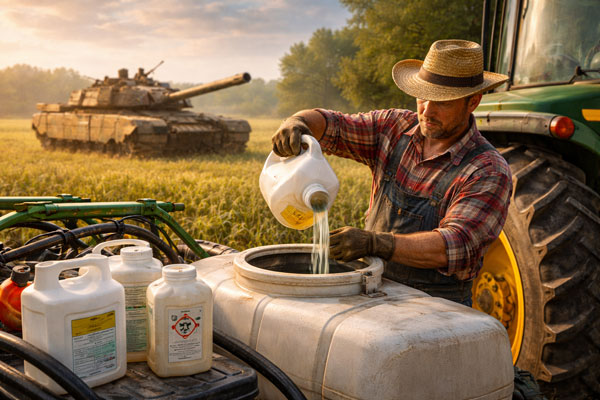
The Glyphosate Era
Today, the dominant herbicide in global agriculture is Glyphosate.
Approximately 280 million pounds are sprayed on millions of acres of farmland each year.
Glyphosate is used not only to kill weeds but also to dry crops before harvest, increasing residues in food such as wheat, peas, beans, legumes, hops, barley, rye, and other grains.
In 2015, the cancer research arm International Agency for Research on Cancer ( IARC) of the World Health Organization classified glyphosate as “probably carcinogenic to humans.” However, the US EPA ignored 67 studies that the IARC reviewed in making its finding.
Thousands of lawsuits have alleged that exposure to glyphosate contributed to non-Hodgkin lymphoma. Glyphosate has been linked to miscarriage, birth defects, autism, liver, kidney, thyroid and nervous system damage, neurological disorders, androgenizing baby girls exposed in utero, and ten types of cancer.
Billions of dollars have already been paid in settlements.
Yet the chemical remains a cornerstone of modern agriculture.
National Security — or Chemical Dependency?
The executive order discussed in the New York Times article justified protecting glyphosate production, in part, on national security grounds.
If the chemical plant producing elemental phosphorus shut down, the United States could lose both:
- Its domestic supply of glyphosate
- It's domestic supply of white phosphorus used in munitions
But this reveals something troubling.
The United States has allowed its food and defense systems to depend on the same chemical infrastructure
That is not resilience.
That is vulnerability.
The Bigger Question
For decades, Americans were told chemical agriculture was necessary to feed the world. Parents fed their children food they thought was safe. Mother struggled with seeing their children develop rashes from food they had just given their toddler. Families argued over food choices with in-laws, children missed school days, and there was an increase of 400% of ER visits by children to hospitals for life-threatening food allergies for the first time in recorded history. Children died from eating what was considered FDA-approved, healthy food. Absurd.
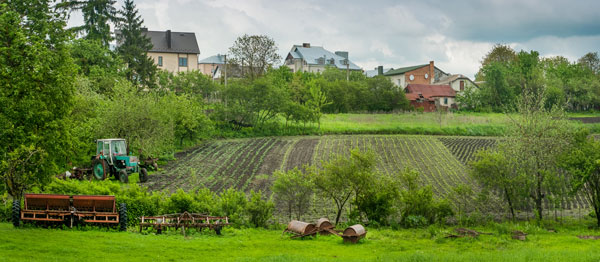
Thankfully, many farmers across the country are now demonstrating that food can be grown successfully using organic and regenerative methods that do not rely on toxic herbicides.
Healthy soil ecosystems can suppress weeds naturally and produce abundant crops without saturating the land with chemicals.
The real question facing our nation is no longer whether we can grow food without these chemicals.
It is whether we have the courage to transition away from them.
Because the true strength of a nation is not measured by the chemicals it can manufacture.
It is measured by the health of its land, its farmers, soldiers, and its children.
For resources on how America can transition away from GMO mono-crop agrochemicals, see our Feed Your Soil page with non-toxic farming solutions, provided to us by our beloved farming advisors.



Showing 1 reaction
Sign in with